Become Antifragile: Tread to abundance with agentic AI
From Strategy Definition to Organization-wide Scaling
September 23, 2025

Agentic AI is not a tech transformation journey but a voyage for business transformation and reinvention. If implemented right, this will free employees from monotonous and drudgery work and give them more time to serve customer and meet their needs. This will usher innovation at rapid pace accelerating firm revenue growth. Sam Altman said in GPT 5.0 release that this is like having a PhD in your pocket. Brace for the ride of our lives. Welcome to the Intelligence Revolution! Welcome to Antifragility!! This is a multi-decade journey with AGI, Super Intelligence and beyond.
The field is rapidly evolving with billions of dollars of investments on chips, foundation models and applications. Enterprises and leaders are inundated with AI information. It becomes imperative for organizations to distill signal from noise. Enterprises have made investments into modern AI but only few have seen the outcomes they were targeting for. NANDA report by MIT says only 5% of AI initiatives has delivered returns. Most enterprises are stuck in the grind of POCs and wasted investments. It is imperative to realize the evolution of modern AI is like a jagged frontier where it does some of the tasks like research and backend automation extremely well but fails on simple tasks.
The pace and intensity of change in modern AI will only increase. As intel founder Andy Grove once said “Only Paronoids Survive”.
Before we talk about implementation of Agentic systems want to ensure we define it. We prefer the Anthropic definition covering both below with some difference:
- Workflows are prescriptive systems where LLMs and tools are orchestrated through predefined code paths
- Agents are systems where LLMs dynamically direct their own processes and tool usage based on goals defined and maintain control on how the accomplish tasks
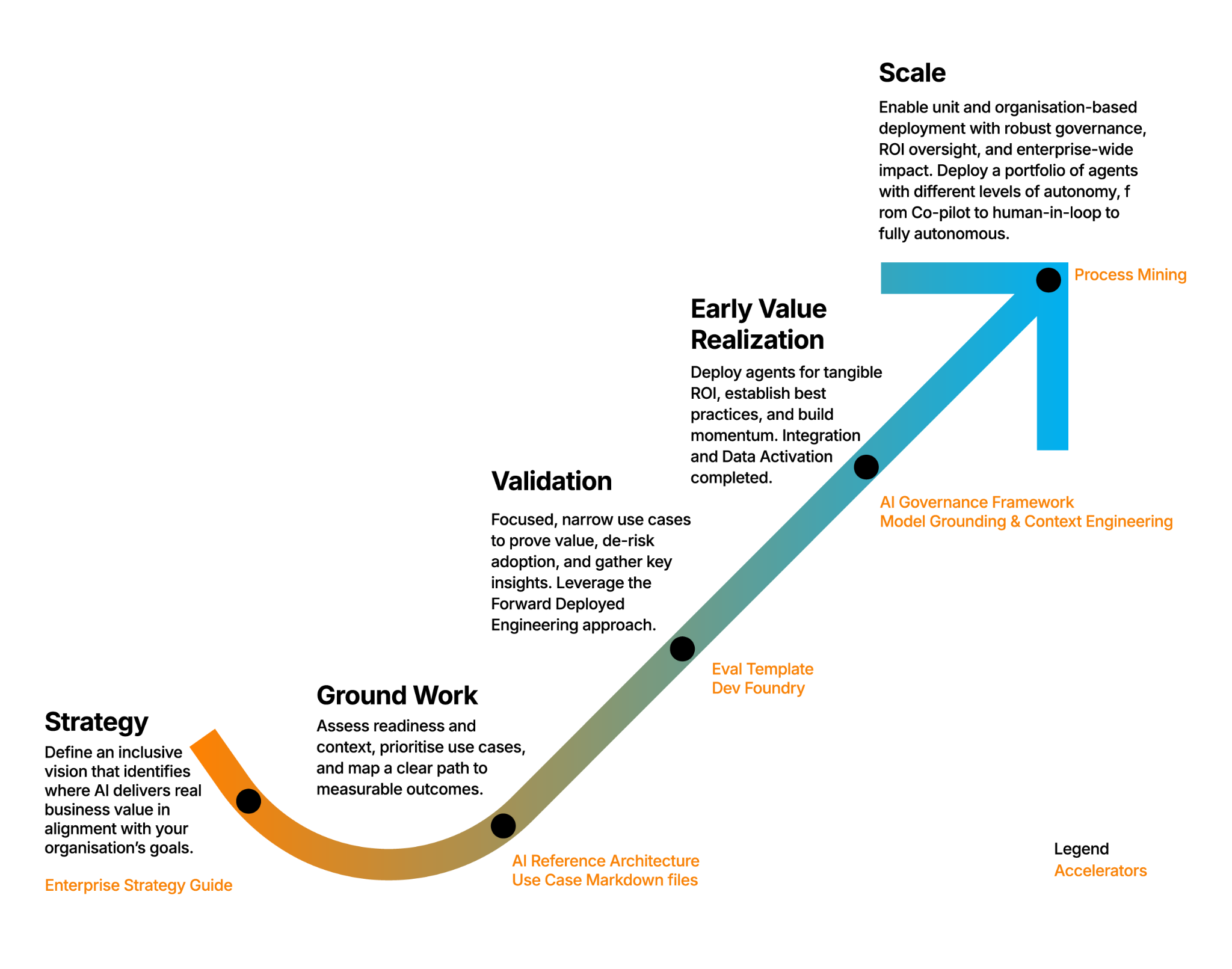
Our blueprint backed by accelerators and frameworks improve the odds of winning in the AI era. The technology is rapidly evolving and has it strengths and limitations:
Not all use cases require modern AI. Some can be done using automation or classical AI
- Strategy.
- As we discussed earlier, AI journey is about business reimagination and reinvention. So, we start with drafting outcomes the organization aspires to achieve, and the role can AI play.
- The intelligence revolution pivot should be used to revisit organization goals and priorities. This will be an input to the AI transformation agenda. The focus on the outset should be on the boring and mundane tasks and making employees effective elevating their focus on customers.
- Not all use cases require modern AI. Some can be done using automation or classical AI.
- AI economics needs to be optimized to ensure the business case of AI is achieved. These cover factors as investments on AI models (multi-model approach including open source), hosting options (self vs public cloud) and AI tools.
- Change and communication strategy need to include small group debates, leadership meetings and townhalls. Fear of unknown needs to be addressed.
- Readiness and Ground Work
- Use case identification to demonstrate AI value has been one of the challenges faced by enterprises. Selecting the appropriate use case will take the enterprise forward on the path of reimagination and rethinking. One of the reasons for limited production impact as highlighted in MIT report has been the failure to idenitify right use cases. More than 50% focused on sales and marketing.
- Use cases are identified and prioritized based on impact, cost and organization readiness. The organization investments on people, technologies and systems are assessed and act as input to prioritize use cases. Data readiness and API availability are also assessed.
- Different enterprises are at different levels of maturity based on technology maturity, talent availability and AI use cases implemented.
- A good place to start is to ensure adoption of off the shelf tools in the firm – ChatGpt or Perplexity for research, Claude Code for software engineering and Gemini for others.
- Data readiness has been a significant challenge in most enterprises. To demonstrate AI value, we can get started with workflow scenarios that may not need significant data plumbing e.g. semantic search of product catalog.
- API availability and readiness is important to enable integration with system of record. Organizations who have experimented with Backend-for-Frontend frameworks would like have sophisticated middleware and APIs. This will ease the implementation of MCP (model context protocol).
- Use cases are plotted on a 2X2 framework - ease of implementation vs impact to prioritize and sequence. At Sumvec AI, we have markdown files for use cases for different industry that can be customized for an enterprise.
- Validation
- We recommend taking a task based approach and solving all the complexities related to the task before spanning horizontally. Helps get deep into AI enabling a task.
- Evals are based on outcomes to be delivered by the use cases identified for implementation. This is aligned with organization goals and AI objectives.
- Forward Deployed Engineering is followed to iterate through the engineering to produce the results. Guardrails are important to ensure the agentic AI delivers results aligned to the context. This keeps the token cost in check
- Data prep needs to be started to implement complex use cases that deliver organization wide impact. Also, MCP implementation could be initiated to enable complex system integrations.
- Enterprise architecture and engineering practices need to be setup. Architecture to be flexible and composable. This will help deliver outcomes at speed and inject agility into enterprise. One of the challenges organization face is the inability to make changes to the course without significant time and effort.
- Choice of development platform to be made. Claude Code or Cursor or Replit are great platforms. Claude Code has an edge for complex enterprise development. Cursor or Lovable for rapid prototyping. Enterprises are also taking multi-tool approach to equip their engineers with right tools for the different use cases.
- Early Value Realization
- Enterprises in this stage get ready to deploy workflows that would reimagine a function wide use case e.g. digital shopping of home loan.
- The approach involves considering each step of the process and redesigning it with AI integration, rather than simply adding AI as an additional component, with the aim of achieving better results.
- AI governance and safety framework is setup to ensure it follows organization policies.
- Access controls for AI agents are setup. Responsible AI frameworks are implemented. Audit reports on performance need to be monitored closely.
- Agent to Agent integration through A2A protocols and integration with backend and external systems need to done. MCP access could have security concerns and need to be well understood.
- Models are hosted on prem or on public cloud. Alignment of models to use cases is also done to ensure token bills are not inflated.
- Open source models will continue to improve. Open AI gpt-oss-20b and gpt-oss-120b with open weights can be hosted on own premises cutting down any usage based token cost. Organization SLMs can be built with fine tuning of public models for organization specific tasks that may not require the latest upgraded model.
- Enterprises will need education on components of Agentic Systems as these are very different from the traditional systems. The number of components will likely be higher and getting them work together for a specific objective requires system thinking. Modern AI system work based on goals aligned (“What”) vs the focus on process (“How”) in the existing systems.
- Scale
- The era of modern AI is evolving rapidly. Speed will be essential. While scaling will start with humans in the loop, but gradually more autonomous AI agents will come to play. This will require flexible wiring of the IT systems.
- Enterprises need to be guided by certain assumptions (or truths) and hypothesis e.g. performance of models will improve significantly over time and all foundation models will have similar token cost and similar capabilities with some nuances of differing performance based on mode of transaction.
- One more constraint will drastically reduce, cost of tokens. This will lead to more voice and video based real time transactions transforming levels of engagement.
- Multi-model engineering will be needed as different tasks require different models based on task complexity.
- Change Management and Talent Skilling need to be executed well. Most jobs and functions, if not all, will be impacted with AI. Focused enablement programs will be needed for management, business teams and IT teams.
- Also, new form factors will emerge. Open AI is already working with Jony Ive to establish new form factor.
- Enterprises will have large swarms of agents, the governance will require detailed planning and likely new set of tools. The capabilities that were relevant for Distributed Systems architecture will be critical for deploying large scale Agentic Systems.
- Agentic Systems will be of two types – agent based and workflow based. Both have LLM handling the orchestration. Workflow based will be used where steps are fixed while agent based will be used where steps can change and LLM will execute the task based on goals.
- RAG, Context Engineering and model fine tuning will be needed for models for different tasks and workflows to reduce hallucination and improve response quality. These will be done iteratively.
- Empowered centralized AI oversight committee needed to review progress, address bottlenecks, accelerate implementation and monitor ROI.
As is the promise of modern AI, organizations will benefit through addition of multiplicative new capabilities leading to radical new relevance. Key challenge remain around use cases to choose for implementation and the technology choices to be made. Integrations with systems of record and data silos will need to be addressed for scaling.
Organizations need to accelerate their journeys. This will be a combination of models, off the shelf software and custom purpose built solutions.